

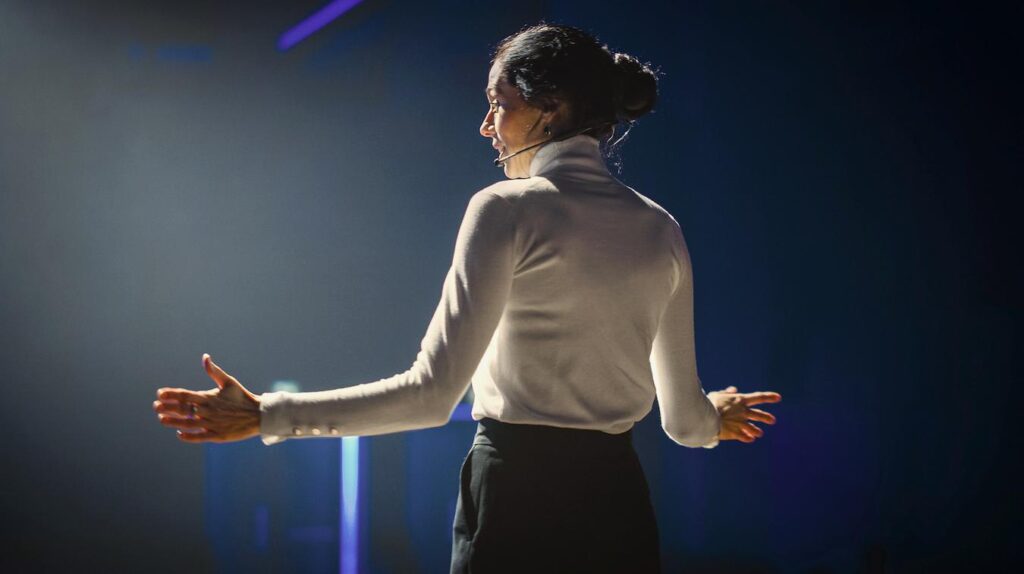
When you stand in front of an audience, individuals in that audience evaluate you immediately. Yes, they’re looking at your clothes, your hair, the expression on your face – all those things contribute to the image you create. But the way you stand and position yourself also speaks volumes.
Posture and balance communicate something vital about what you think of yourself. And your audience will not afford you any more respect than you give yourself.
Do you slouch? Do you lean? Do you shove your hands in your pockets or cross your arms tightly across your chest, drawing yourself into the smallest target you can create? Or do you stand tall? Is your body open to your audience? Do you carry yourself in a way that exudes friendly, approachable confidence?
Our Chief Angel Officer, Anne Boyd Moore, when CEO of Ty Boyd Inc, spent much of her time instilling awareness of poise and posture, particularly in our female clients. “Even women who are smaller in stature can create a powerful presence in the way they carry themselves,” Anne said.
She also pointed out that the way we carry ourselves has a powerful impact on how we feel, on the kind of emotional energy we bring to our circumstances. “When I’m having a rotten day, I know that if I stand tall and put a smile on my face, I feel better. I have more confidence. I might be in some discomfort about what’s going on in my life, but when I put that kind of tool to work in my life, when I choose confidence and positivity, those things begin to manifest in me. I begin to feel better.
“Just smile and stand taller and see how you feel.”
She was right.
Two other aspects of our physical presence is movement and gestures.
Some of us don’t move enough, clinging to a lectern as if it were the only thing keeping us upright. Others of us move way too much. We move purposelessly, working off our nervous energy. Pacing back and forth makes us feel good, but does nothing for the audience.
We have to learn to make our movements work for us, not against us.
One of the first things we must learn is that we won’t always have a lectern to hide behind. And it is actually a barrier to effective communication. So we must learn to feel comfortable without the lectern as a prop or a crutch.
Here are some quick tips:
• Always look like you’ve got somewhere to go and something to say. Move with purpose. When there is no reason to move, stand planted.
• Speak from a balanced position. That means not leaning against the lectern, not draped over a flipchart.
• Keep your hinges greased by searching out those good reasons to move: to point at someone who has a question, to move in the direction of that person, to reach for a legitimate prop or visual aid.
With gestures, a good rule of thumb is, “If your hands are comfortable, your audience is comfortable”.
Pulling fingers, jingling coins in your pockets, the “Flashing Fig Leaf”, all reveal your insecurity.
Using your hands from a position of power – with authority, with confidence, with ease – lends you power. And those gestures may also lend color and character to your presentation.
Here are a few simple tips for using gestures more effectively:
When using visual aids such as a flipchart or whiteboard, always put the chart on the opposite side of your writing hand. This way, you won’t have your back squarely to the audience. And remember to use the TTT technique – touch, turn, talk. Touch (write or point to) the flipchart, turn back to the audience, then talk to them. Don’t talk while you write. Talk only when you can make eye contact, when your voice won’t be muffled.
Plan movements as carefully as you plan the content of your talk, and practice them until your gestures, too, are second nature. Watch other presenters and make note of the variety of movements and gestures they use. Then give some thought to how those gestures can punctuate the key points you want to emphasize in your talk; the emotions you want to enhance; the responses you want to generate.
Break up the pace and tempo of your movements. Move quickly to show your excitement, slow down to convey thoughtful deliberation. Sweep the room with an arm to draw them all in.
When you focus on posture, poise, and movement when speaking, you will command attention like no other.